The ocean is far more than a massive stretch of blue water; it is the life-support system of our planet. Covering over 70% of Earth’s surface, the ocean shapes our climate, supports millions of species, and provides essential resources for human life. Yet despite its importance, much of it remains unexplored and increasingly threatened. Understanding the importance of oceans is the first step toward protecting them.
The Architect of Climate
The ocean acts as Earth’s climate control system. Because water has a high heat capacity, the ocean absorbs enormous amounts of solar energy. This heat is then transported around the globe through a system of currents known as the Global Ocean Conveyor Belt.\
This movement of heat prevents extreme temperature differences between regions, stabilizes weather patterns, and maintains the habitability of many parts of the world. The ocean also functions as a carbon sink, absorbing approximately 25% of the carbon dioxide produced by humans, which helps slow the pace of global warming.
Why this matters
- It prevents extreme temperature differences between regions
- It stabilizes weather patterns
- It keeps many parts of the world liveble
Without the ocean’s heat‑moving currents, large regions of Earth would be too hot or too cold for human life.
The ocean also functions as a carbon sink, absorbing about 25% of human‑produced CO₂ (NOAA). This slows the pace of global warming and reduces the amount of greenhouse gases in the atmosphere.
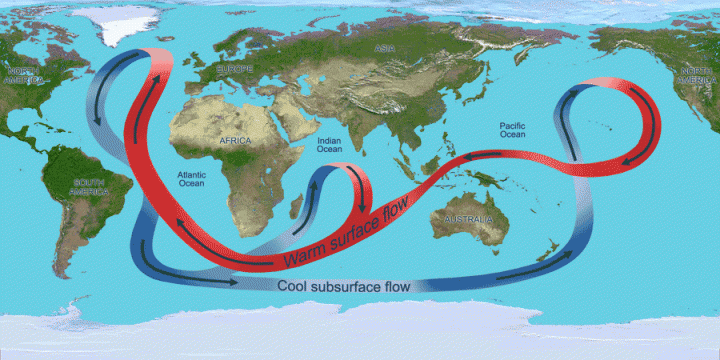
A diagram of the Global Ocean Conveyor Belt.
A Hidden World of Biodiversity
Life began in the ocean, and today it remains home to an estimated 80% of all life on Earth. Scientists divide the ocean into zones based on depth and sunlight.
Ocean Zones
- Sunlight Zone (Epipelagic)
- Bright, warm, and full of life
- Home to coral reefs, sea turtles, and most fish
- Twilight Zone (Mesopelagic)
- Dim and mysterious
- Many species use bioluminescence
- Midnight Zone (Bathypelagic)
- Pitch‑black, freezing, and high‑pressure
- Creatures look almost alien
Marine plants and algae, especially phytoplankton, produce over 50% of the oxygen we breathe. Every second breath you take is thanks to the ocean.
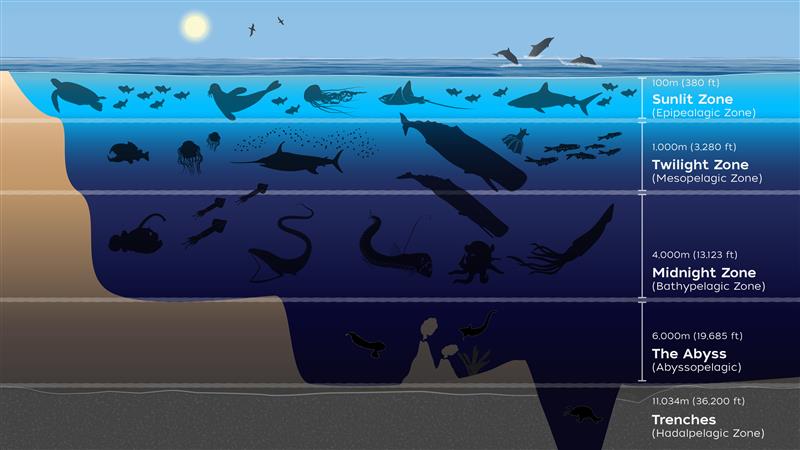
An image of ocean zones and deep‑sea creatures.
The Human Connection
For thousands of years, humans have relied on the ocean for food, travel, culture, and discovery.
How the ocean supports us
- Economy: Over 90% of global trade moves by sea.
- Nutrition: More than 3 billion people depend on marine biodiversity for food and income.
- Exploration: We have mapped more of the Moon and Mars than the deep ocean floor.
The importance of oceans extends into every part of human life—even if we don’t always notice it.
⚠️A Call for Stewardship⚠️
Despite its power, the ocean is fragile. Human activity is pushing it toward a tipping point.
Major threats
- Plastic pollution
- Overfishing
- Ocean acidification
- Coral bleaching
- Habitat destruction
Ocean acidification is especially dangerous. When CO₂ dissolves into seawater, it forms carbonic acid, lowering the pH. This makes it harder for shellfish, corals, and plankton to build their skeletons—threatening the entire marine food web. Ocean acidification is especially dangerous. When carbon dioxide dissolves into seawater, it forms carbonic acid, lowering the pH. This makes it harder for shellfish, corals, and plankton to build their skeletons, threatening the entire marine food web.
Protecting the ocean is not really optional, but Protecting the ocean is essential for human survival. To move forward, scientists and policymakers emphasize the need for a Blue Economy, a system that uses ocean resources responsibly while restoring marine ecosystems.
To move forward, scientists and policymakers emphasize the need for a Blue Economy—a system that uses ocean resources responsibly while restoring marine ecosystems.
Conclusion: Our Responsibility to the Blue Planet
The ocean regulates our climate, produces our oxygen, supports global economies, and sustains life on Earth. Understanding the importance of oceans is the first step toward protecting them. Whether through reducing plastic use, supporting sustainable seafood, or advocating for conservation policies, every action matters.
The ocean is the pulse of our planet. Protecting it means protecting ourselves.
Sources
- NOAA – “How Much Carbon Does the Ocean Absorb?”
- Smithsonian Ocean – “Ocean Life & Ecosystems”
- National Geographic – “Phytoplankton and Oxygen Production”